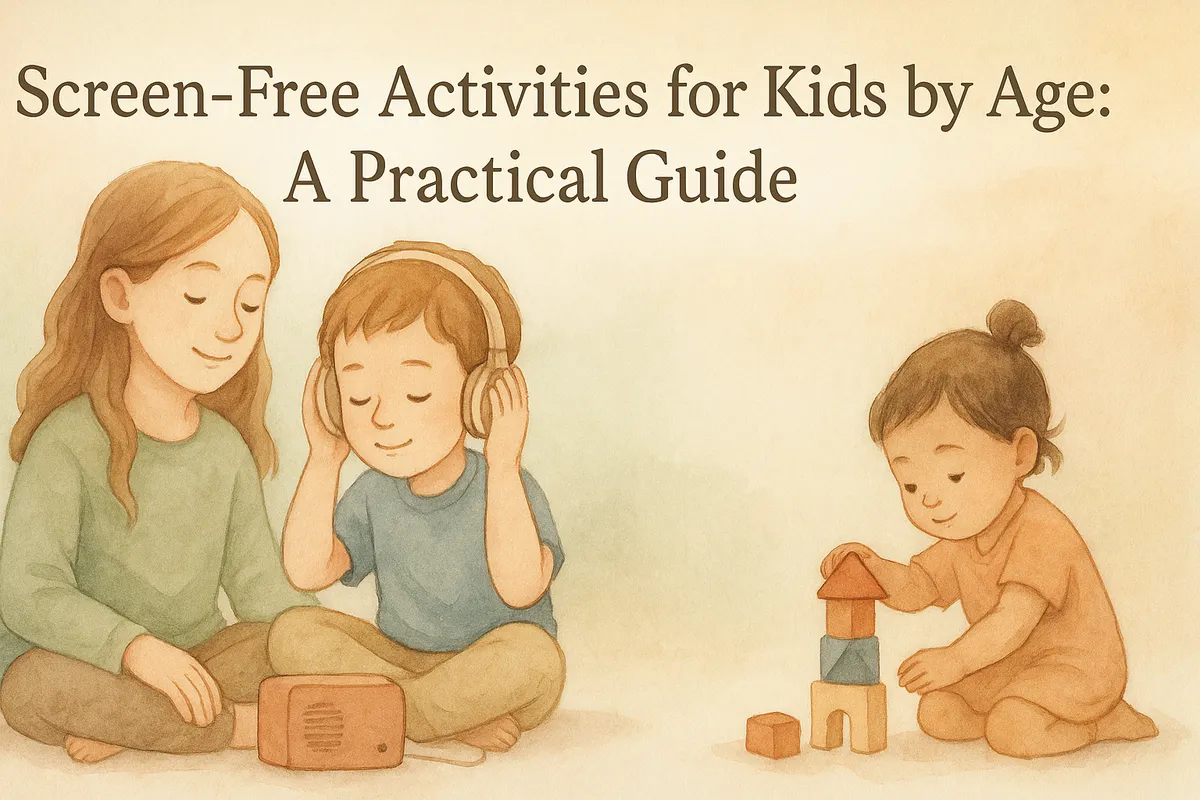
Struggling to keep your kids entertained without screens? Here are age-appropriate screen-free activities for kids aged 2 through 10, including audio stories and creative play.
Compatibility note: Fablino creates standard MP3 audio files that can be loaded onto Toniebox, Yoto Player, FABA, and other MP3-compatible devices. Fablino is not affiliated with, endorsed by, or sponsored by Boxine GmbH (Toniebox®), Yoto Ltd (Yoto®), or any FABA trademark owner. All third-party brand names are the property of their respective owners.
See our full Trademark Disclaimer →You know your child is getting too much screen time. You also know that saying "go play" while taking away the iPad is a recipe for a meltdown. The trick is having specific alternatives ready before the screen comes off.
Here are screen-free activities that actually work, organized by age because what entertains a 3-year-old is very different from what works for a 7-year-old.
Ages 2-4: Sensory Play and Simple Stories
Toddlers and young preschoolers are sensory learners. They need to touch, hear, and move. Screen-free doesn't mean you have to entertain them every second -- it means setting up environments where they entertain themselves.
Activities That Work
Water play. A plastic tub with cups, funnels, and spoons on the kitchen floor. Add food coloring for extra excitement. Twenty minutes of quiet, guaranteed.
Play dough station. Homemade or store-bought, with cookie cutters and plastic utensils. This keeps most toddlers engaged for 15-30 minutes.
Audio stories. This is the underrated one. A Toniebox, Yoto player, or simple Bluetooth speaker playing a bedtime story gives your toddler focused listening time -- which is both screen-free and helps develop attention span. Start with 3-5 minute stories. Personalized stories (where they hear their own name) hold attention even better.
Sticker books. Cheap, portable, and quietly engaging. Stock up.
Nature walks. Even 15 minutes in a garden or park resets a toddler's mood. Let them collect leaves, rocks, or sticks. The "collection" becomes the activity.
Block building. Duplo, Mega Bloks, or plain wooden blocks. Build a tower, knock it down, repeat forever.
What Doesn't Work at This Age
- Complex board games (too many rules)
- Solo reading (they need you for that)
- "Go play in your room" without setup (leads to chaos)
Ages 5-7: Imagination and Independence
This is the golden age for screen-free activities. Kids are old enough to play independently but still young enough to get fully absorbed in imaginative play.
Activities That Work
Drawing and art supplies. Keep a dedicated art drawer stocked with paper, crayons, markers, scissors, and glue. When they say "I'm bored," point them to the drawer.
Audio stories and podcasts. At this age, kids can follow longer stories (8-15 minutes) and start requesting favorites. A Toniebox with multiple Creative Tonies loaded with different stories gives them control -- they pick the figurine, they pick the story. Fablino works well here because kids this age love hearing stories about themselves going on adventures.
LEGO free-building. Not the instruction sets -- a box of mixed bricks and their imagination. "Build me a spaceship" is 45 minutes of focused, screen-free play.
Treasure hunts. Write clues on paper, hide them around the house. Takes 10 minutes to set up, provides 30 minutes of excitement.
Dress-up and pretend play. A box of old clothes, hats, and accessories. They become pirates, doctors, chefs, or superheroes. This is brain development disguised as fun.
Kitchen helpers. Let them stir, pour, and measure. Make cookies, pizza dough, or smoothies together. Messy but memorable.
Outdoor free play. Bikes, scooters, chalk on the driveway, digging in the garden. At this age, if you get them outside, they usually figure out the rest.
What Doesn't Work at This Age
- Activities that require constant adult supervision (defeats the purpose)
- Anything too easy (they get bored instantly)
- Competitive games without siblings (they need an opponent)
Ages 8-10: Projects and Challenge
Older kids need activities with a purpose. "Go play" doesn't work because they're past simple imaginative play but not yet old enough for full independence. They need projects.
Activities That Work
Book series. Once a kid this age gets hooked on a series (Percy Jackson, Diary of a Wimpy Kid, Dog Man), they'll read for hours. Visit the library, let them choose.
Chapter audiobooks. The next level up from short stories. Services like Audible or free chapter-by-chapter downloads from LibriVox keep 8-10 year olds engaged on long car rides or quiet afternoons. For bedtime, shorter serialized stories work better -- Fablino's Story Sagas create multi-chapter adventures that continue night after night.
Building kits. LEGO Technic, model kits, or electronics kits (Snap Circuits, littleBits). These provide hours of focused activity with a tangible result.
Journaling and comic creation. Give them a blank notebook and suggest they create their own comic series. Many kids this age are natural storytellers -- they just need the medium.
Cooking real meals. Not just stirring -- actually following a recipe. Supervise but let them lead. Scrambled eggs, pancakes, and simple pasta are good starting points.
Board games and card games. Ticket to Ride, Catan Junior, Uno, chess. These develop strategic thinking and work well as family activities.
Outdoor sports and exploration. At this age, kids can ride bikes further, climb trees, build forts, and organize neighborhood games. Give them boundaries and freedom.
What Doesn't Work at This Age
- Activities designed for younger kids (they'll feel patronized)
- Open-ended "be creative" without tools or materials
- Solo activities when they want social connection (arrange playdates)
Audio Stories: The Overlooked Screen-Free Tool
Audio stories deserve their own section because they solve a specific parenting problem: what to do when your child needs to be entertained but shouldn't have a screen.
This includes:
- Bedtime -- stories in the dark help kids fall asleep
- Car rides -- long drives without a tablet
- Quiet time -- the post-nap period when you need 30 minutes
- Rainy days -- when outdoor play isn't an option
The Toniebox, Yoto Player, and similar devices are purpose-built for this. They give kids physical control (place a figurine, push a button) without a screen.
Personalized stories add another layer. When a child hears their name in a story, they pay attention differently. It's not just entertainment -- it's their adventure. Fablino creates these in about 90 seconds with professional narration, downloadable as MP3 for any audio player.
The free tier (3 stories per month) is enough to add a weekly "special story" to your screen-free rotation.
Making Screen-Free Time Actually Stick
Don't Announce It
"We're doing screen-free time now!" creates resistance. Instead, just start an activity. "Hey, want to help me make cookies?" works better than "No more iPad, go find something to do."
Have a Rotation Ready
Write down 10 activities your child enjoys. When screens go off, pick one from the list instead of asking "what do you want to do?" Decision fatigue is real for kids too.
Accept Boredom
Kids need to be bored sometimes. Boredom is where creativity starts. If they complain for 10 minutes and then build an elaborate pillow fort, that's a win.
Start Small
If your child is used to 3 hours of daily screen time, going cold turkey will fail. Replace one screen session per day with a specific alternative. Build from there.
Make Audio the Default
When your child reaches for the iPad, redirect to the Toniebox or audio player. "You can listen to a story while you play with your blocks." Over time, audio becomes the automatic choice.
The Bottom Line
Screen-free doesn't mean entertainment-free. It means swapping passive consumption for active engagement -- whether that's building with LEGO, drawing, cooking, or listening to a story in the dark.
The secret is preparation. Have the activities ready, the audio loaded, and the art supplies stocked. When the moment comes to put the screen away, you want to say "let's do this" instead of "go find something."
Your kids won't thank you now. But the creativity, attention span, and imagination they develop will show up in ways that matter.
Create Your Child's Story
Make your child the hero of their own personalized bedtime story with professional narration.
Try Fablino FreeRelated Stories
Transforming Car Rides with Personalized Audio Stories
Discover how personalized audio stories can transform stressful car rides into engaging adventures your kids will actually look forward to—no screens needed.
Transforming Quiet Time with Personalized Stories for Kids
Discover how personalized audio stories can transform chaotic quiet time into peaceful moments your child actually looks forward to, while building listening skills.
How Personalized Stories Can Combat Nighttime Anxiety in Kids
Personalized audio stories — where your child is the hero — are one of the most effective tools for easing nighttime anxiety. Here’s why they work, and how to use them.